
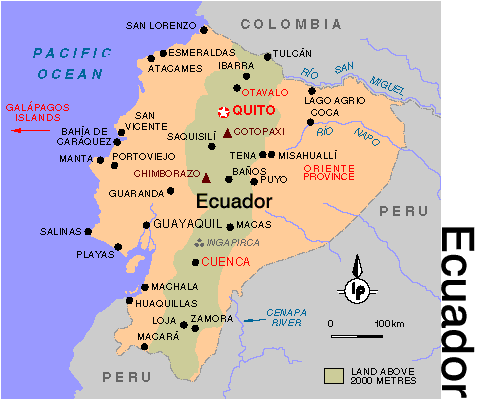
Quito, the capital of Ecuador, is the highest capital in the world with an elevation of 2850 metres above sea level. Although La Paz is higher, it is not the official capital of Bolivia, which is Sucre.
Quito was built on a long plateau flanked by volcanoes. Some of them can be visible from the city on a clear day.
Quito was built on a long plateau flanked by volcanoes. Some of them can be visible from the city on a clear day.
The capital of Ecuador was founded in 1534 as a result of conflicts between the indigenous people and the Spanish colonizers.
Although Quito is the capital, Ecuador´s business centre is Guayaquil, a city on the shores of the Pacific Ocean. The Ecuadorian economy is based on the production and exportation of oil (80% in Amazon and 20% in Esmeraldas). Shrimp is the second most exported product, followed by bananas (there are about seven different types of bananas), cocoa, roses, coffee and lately tourism.

Beautiful roses in Hotel Casa San Marcos
The currency in Ecuador is the American dollar. Only some coins are different from the American ones and are only accepted in Ecuador.

Cerro El Panecillo is a hill with a monument to the Virgin Mary. The 41 metres tall structure is the highest aluminium monument in the world.
It was created by the Spanish artist Agustín de la Herrán Matorras and was inspired by the famous Virgin de Quito sculpted by Bernardo de Legarda in 1734, which decorates the main altar at the Church of St. Francis.

The 7000 pieces came from Spain and were assembled on a high pedestal on the top of El Panecillo (small bread in Spanish) and is visible from most of the city of Quito.

Plaza de la Independencia is the heart of the historic center, also known locally as the Plaza Grande. This garden square is dominated by the Metropolitan Cathedral. At the center of the plaza is a bronze and marble monument celebrating Ecuador’s first declaration of independence against its Spanish conquerors, in 1809.

Quito’s cathedral is believed to have existed first as a wood and adobe structure before the official church was built on the site in 1565.


La Basílica del Voto Nacional took over 100 years to build. The first stone was placed in 1892. It is the largest Gothic basilica in Latin America. It is often compared to the Cathedral of St Patrick in New York and Notre Dame in Paris.




I am aware Quito has much more to offer. I will explore it next time I go to Ecuador.
Quito is home to several beautiful churches, which gave the city its reputation as the “cloisters of America”. The current street Garcia Moreno (former President of Ecuador) was called Calle de las Siete Cruces (Street of the Seven Croces) because it was flanked by seven churches.
I couldn´t help taking a picture of the Portuguese actor Diogo Morgado in a church in Quito.
La Compañía de Jesús is the greatest expression of the Baroque style in Ecuador. This impressive Jesuit church (1605-1765)) took 160 years to finish. Its altars are covered in gold leaf and the fine paintings on its vaulted ceiling have earned it the nickname “Quito’s Sistine Chapel.” The walls are covered with School of Quito murals.
It was severely damaged by the 1987 earthquake. It took 19 years to restore, but now can be seen in its full splendour.
El Monasterio de San Francisco is the largest structure in colonial Quito, with a sumptuous Spanish Baroque interior. It is the oldest church in the American continent (Construction works began a few weeks after the founding of the city in 1534) and houses over 3500 works of colonial art, of varied artistic styles, most notably those of the famous Quito School of art and the city's beloved Virgin of Quito (1734). It is in front of the plaza with the same name which was a famous indigenous market.
La Basílica del Voto Nacional took over 100 years to build. The first stone was placed in 1892. It is the largest Gothic basilica in Latin America. It is often compared to the Cathedral of St Patrick in New York and Notre Dame in Paris.
La Ronda or Juan de Dios Morales St, with its white houses decorated with ornate balconies and geraniums, was restored around 2005 and has become a mix of old-time artisans and popular cafés and restaurants with a bohemian feel, like Bairro Alto in Lisbon. La Ronda’s name comes from the guitar serenades (rondas) that made crowds move here during colonial days.
It was here I learned Quito has a tourism police
Teatro Bolívar is a gorgeous Art Deco theater that was inaugurated in 1933, and soon became the setting for the very best operas, ballets, concerts, and plays seen in Ecuador, as well as a meeting place for high society. The theatre suffered a disastrous fire in 1999. Although it was restored outside, a lot of work is still needed inside.
The National Theatre of Sucre was inaugurated in 1886 and is one of the oldest in South America.
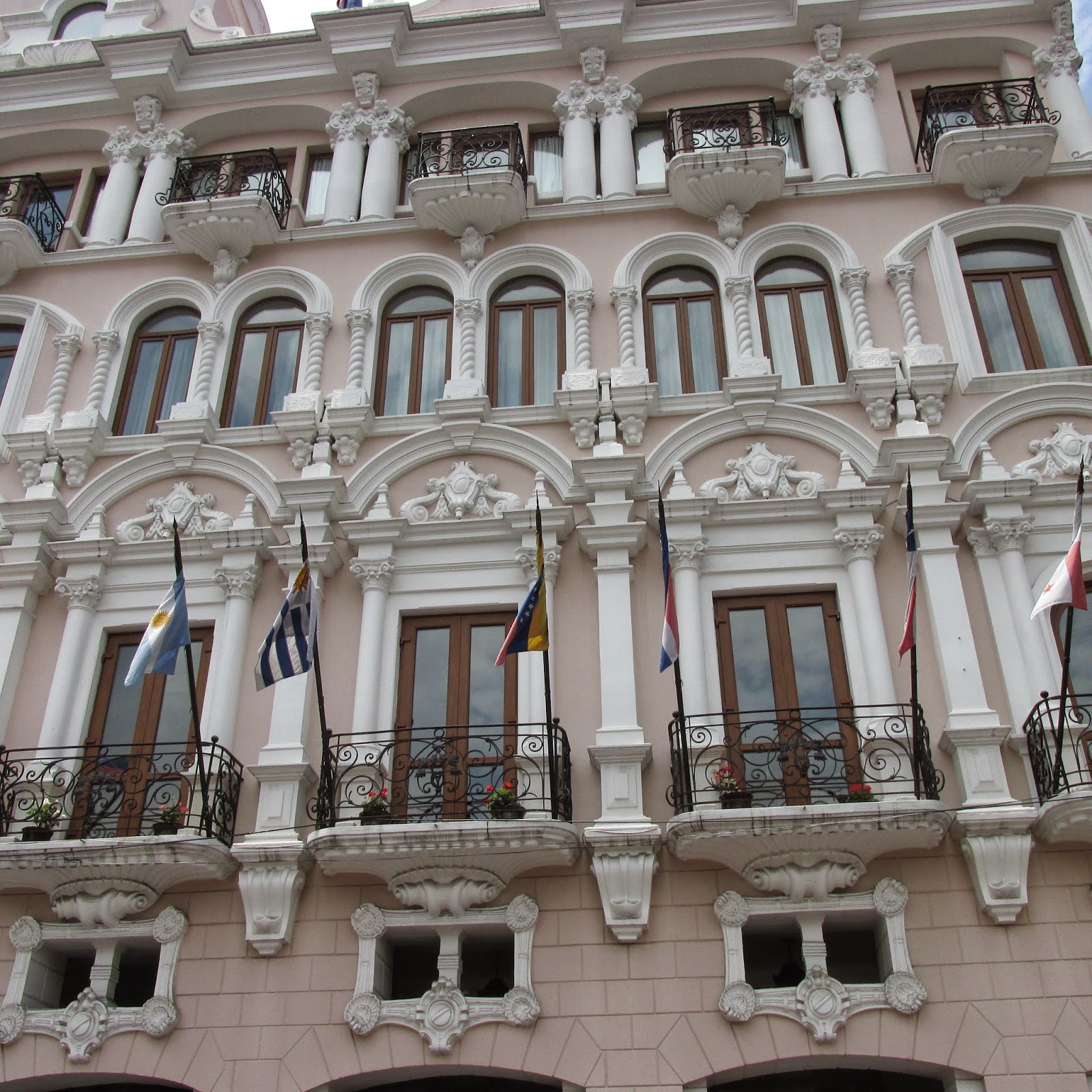
The old centre of Quito is one of the largest and best-preserved historic centers in South America.
Mariscal Foch is right in the centre of modern Quito.
There you can find many restaurants, bars as well as a wide selection of handcraft shops (artesanias) some of them of excellent quality mixing the traditional models with modern design.


